
Por Justo Martin, Sevilla, 13 febrero 2026. https://www.linkedin.com/in/justomartinmartin/
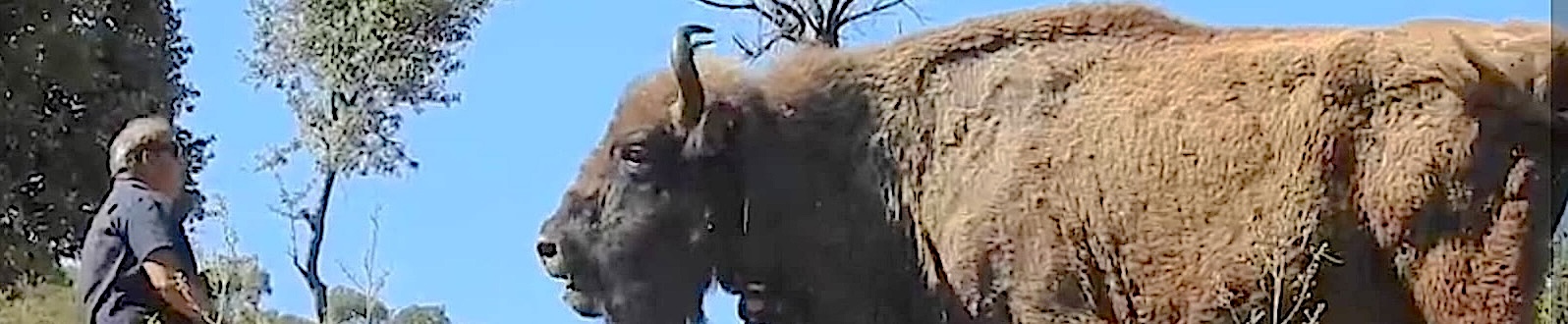
Pie de foto, de izq. a dcha.: Justo Martín, Javier Castroviejo y Fernando Morán.
I met Fernando 15 years ago, a few days after his first transport of bison from Poland, and if something was clear to me from the beginning is that it was, in zoological terms, a unique specimen. I can’t think of another way to define a guy who when he was studying veterinary career, put on headphones and listened to ACDC at full speed to concentrate.
Great conversationalist, wherever he was he became in moments the pole of attraction of the gathering, with a waste of enthusiasm and locution in his speech from which it was difficult to escape and not get infected; and he did it with the same intensity and ease in two languages, multiplying the forums of potential receivers. You could agree with him or not, question his arguments or actions, but there is no doubt that he had an overwhelming personality, he was a real whirlwind. His laughter was as deep as his anger and he felt with the same intensity both victories and defeats, which only motivated him to undertake new battles.
He was also a person of action; that does not mean that he was impulsive, on the contrary; he meditated and thought with great care everything he did; yes, once he made a decision, convinced of himself, he launched himself to execute it without caring who or what he put in front of him. Perhaps that is why he was not too a friend of science, his doubtful behavior and his pace of advance seemed too slow for his way of being and acting. Thus, he was admired and denigrated in equal parts, by those who applauded his resolution capacity and those who were wary of his approaches, procedures and even true intentions.
Among other things of his personality, all this helps to explain something so unprecedented as that a veterinarian, without any kind of scientific or conservationist training, went in a few years from not even knowing that there was a European species of bison, to being acclaimed as one of the world’s greatest exponents of conservation efforts.
The list of projects that Fernando developed while so many or more were born and bubbling in his head was always endless. Like the trips he made through Spain and Europe to get to know places and interested people, it was almost impossible to follow his trail. The telephone conversations to catch up never lasted less than an hour, in which he consumed almost everything, and in short. Anyway, Fernando was a guy who didn’t live life, he devoured it; he was a cyclone for himself, whether it was leisure or work. Maybe that’s why he left us early, maybe his vital frenzy spent his reserves faster than he could replenish them.
Ironies of life, fate wanted that, as a modern Cid Campeador, he won his last battle after death. He always had the intuition (denigated by many “experts”) that the European bison had lived with us until relatively recently, that his absence of fossil records was only a reflection of the lack of discoveries, and that sooner or later he would end up appearing in one place or another. As a wonderful posthumous tribute, a few weeks after leaving, the remains of a 4,000-year-old European bison were discovered in Navarre, certifying that, centuries after the Egyptians built their pyramids, the bison trotted through the Iberian meadows with our ancestors. In the end, Fernando was right: his mission, as many denounced him, was not to bring an intruder from the distant eastern forests, but to return to his domains the disappeared king of the Iberian fauna.


